How to Turn One Coloring Book Niche Into a Repeatable KDP Series
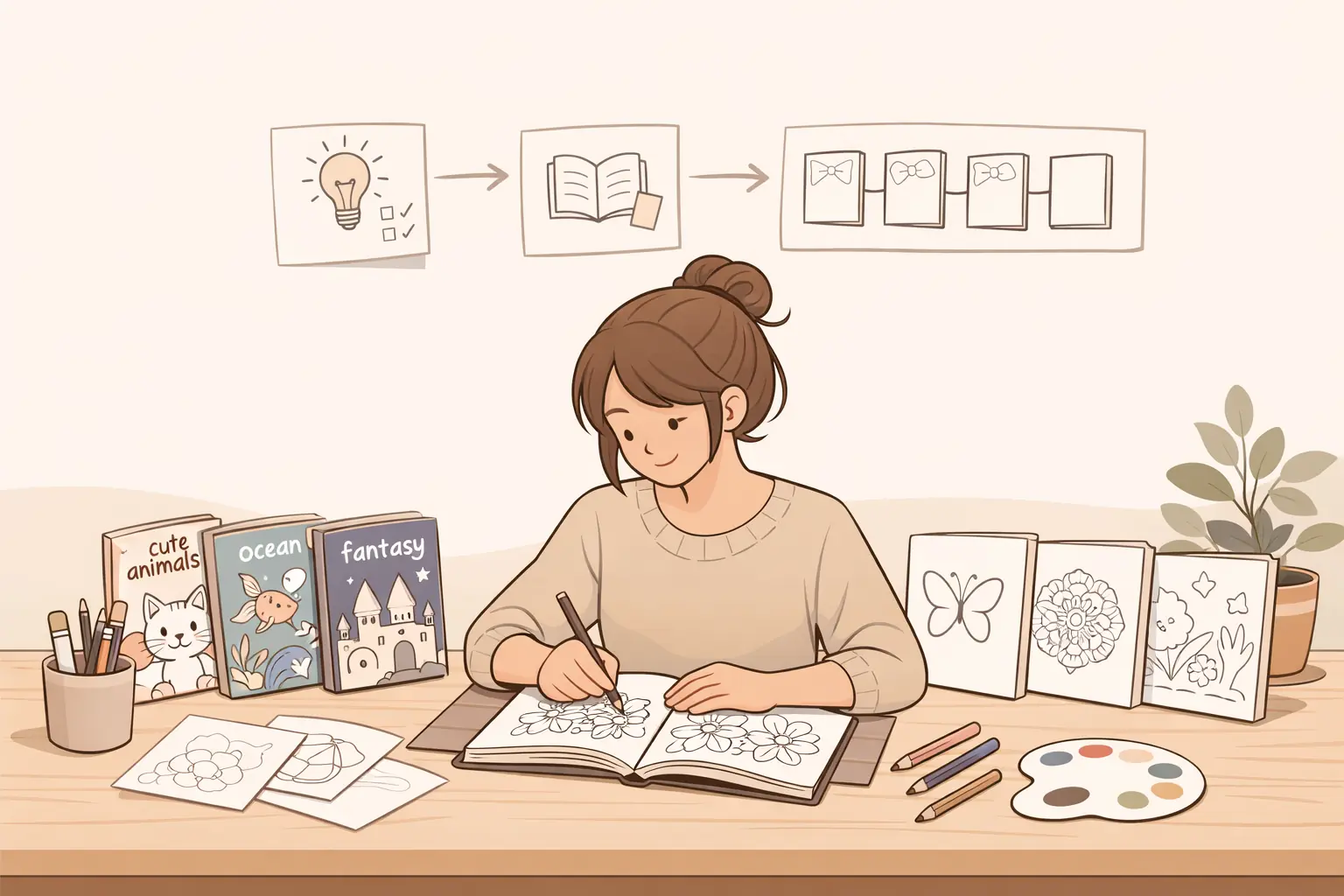
Publishing one coloring book can teach you a lot. Publishing a connected series can teach you even more, because it forces you to think beyond a single idea and build a repeatable workflow.
For KDP creators, that matters. A one-off coloring book might work if the niche is strong, the cover is clear, and the timing is right. But a series gives you more chances to test adjacent angles, serve the same buyer in different ways, and make your production process less random.
The risk is that many creators confuse a series with simple duplication. They take one book, swap the cover color, change a few prompts, and publish another version that does not give buyers a new reason to care.
That is not a series strategy. It is clutter.
This guide shows a more practical way to turn one coloring book niche into a repeatable KDP series while keeping each book distinct, useful, and realistic to produce.
Start with a niche that can stretch

Not every coloring book idea deserves to become a series. Some ideas are naturally narrow. Others have enough depth to support multiple books without feeling repetitive.
A strong series-ready niche usually has at least one of these traits:
- multiple subtopics
- multiple skill levels
- multiple buyer segments
- seasonal variations
- different use cases
- enough visual range to support fresh interiors
For example, "cute animals coloring book" is broad, but it can stretch into more specific directions:
- cute woodland animals
- cute ocean animals
- cute baby animals
- easy cute animals for kids
- cozy cute animals for adults
The same logic works for adults:
- cozy houses
- cottage gardens
- cozy kitchens
- rainy day interiors
- small town shops
The point is not to create endless variations. The point is to ask whether the niche has enough natural branches that a buyer can understand why another book exists.
Define the series promise before the second book
Before you publish another book in the same niche, write down the promise of the series in one sentence.
For example:
- Simple animal coloring books for preschoolers who need bold, friendly pages.
- Cozy adult coloring books built around calm indoor scenes and low-stress detail.
- Seasonal activity coloring books for parents who want quick printable-style entertainment in book form.
- Easy mandala coloring books for beginners who want large shapes instead of dense patterns.
This sentence helps you avoid drifting. If the next book does not fit the promise, it may belong in a different series or should not be made at all.
A clear series promise also helps with covers, subtitles, descriptions, and internal planning. You are no longer making "another coloring book." You are making the next useful member of a defined product line.
Separate the repeatable parts from the variable parts
A good series has consistency and variation. If everything changes, buyers do not recognize the connection. If nothing changes, the books feel redundant.
Separate your system into two lists.
Repeatable elements might include:
- trim size
- page count range
- interior complexity
- cover structure
- title format
- audience level
- line-art style
- description structure
Variable elements might include:
- theme
- season
- subject matter
- difficulty progression
- activity mix
- scene type
- character set
- prompt direction
For example, a preschool series might keep the same trim size, bold-line style, age range, and simple title structure. The variable element could be the subject: farm animals, ocean animals, dinosaurs, vehicles, and bugs.
An adult relaxation series might keep the same detail level, cover layout, and calming promise. The variable element could be the environment: cozy cafes, tiny libraries, garden cottages, rainy windows, and quiet kitchens.
This structure keeps production efficient without making the books interchangeable.
Build a niche map instead of a random idea list
A niche map is a simple planning document that shows how one niche can branch into related books.
Use four columns:
- core buyer
- book angle
- visual direction
- reason this book is distinct
Here is a simple example:
| Core buyer | Book angle | Visual direction | Distinct reason | |---|---|---|---| | Adults who like cozy coloring | Cozy cafes | coffee counters, pastries, window seats | social, warm, food-adjacent scenes | | Adults who like cozy coloring | Tiny libraries | shelves, reading chairs, lamps | quieter bookish atmosphere | | Adults who like cozy coloring | Cottage kitchens | teapots, cabinets, baking scenes | home and comfort focus | | Adults who like cozy coloring | Rainy windows | indoor views, blankets, plants | weather-driven relaxation angle |
The fourth column is the most important. If you cannot explain why the book is distinct, you may be planning a duplicate.
Validate the next book before producing the full interior
Once the first book is live or at least fully planned, you do not need to build the next full book immediately. Validate the direction first.
Useful validation checks include:
- Amazon search suggestions around the subtopic
- competing book covers and subtitles
- review patterns on similar books
- whether the buyer segment is clear
- whether the visual concept is strong enough for a cover
- whether you can generate 30 to 50 page ideas without repeating yourself
That last check is especially practical. If you can only think of 12 page ideas before the concept becomes repetitive, the book may be too thin for a standalone series entry.
Validation does not prove a book will sell. It helps you avoid spending production time on ideas that are weak before they reach KDP.
Design the series so each title can stand alone
A KDP series should not require the buyer to understand your whole catalog. Each title still needs to work as an individual product.
That means each book should have:
- a clear audience
- a clear theme
- a cover that communicates the theme quickly
- a subtitle that explains the use case
- interior pages that match the promise
Do not rely on the series concept to carry a weak book. If "Book 3" only makes sense because someone saw Book 1 and Book 2, it may be too dependent on the series.
For low-content and coloring books, most buyers are browsing individual listings. They may never see your whole product line. Build the series connection, but make every book understandable on its own.
Avoid near-duplicate interiors
This is where series planning can go wrong.
A repeatable workflow should make production faster, but it should not produce books that feel like lightly shuffled versions of the same interior.
Avoid:
- reusing the same page concepts with minor subject changes
- publishing books with nearly identical composition patterns
- changing only titles and covers
- making the visual style so rigid that every page feels predictable
- stretching a niche after the useful ideas are gone
Instead, use a page planning grid. Before production, group pages by scene type or activity type.
For a cozy adult book, the groups might be:
- full-room scenes
- object collections
- window views
- table settings
- small decorative scenes
For a kids activity coloring book, the groups might be:
- single-object coloring pages
- trace-and-color pages
- matching pages
- simple mazes
- counting pages
This keeps the interior varied while still fitting the series promise.
Use Coloring Book Engine where speed changes the decision
Coloring Book Engine is most useful in this workflow before you commit to a full series build.
It can help you:
- test several sub-niche directions quickly
- compare page styles before choosing a series format
- create sample interiors for different buyer segments
- see whether an idea has enough visual range
- move from concept to draft pages without starting from a blank document
It does not replace category research, cover judgment, or KDP listing strategy. Those still matter. But it can shorten the early creative loop, which is where many creators waste time on ideas that looked good in a spreadsheet but did not work visually.
For a series, that speed matters because you are not only testing one book. You are testing whether the niche can support a repeatable product line.
A simple series workflow
Here is a practical order:
- Choose one validated niche with room to branch.
- Write the series promise in one sentence.
- List repeatable and variable elements.
- Map three to six possible book angles.
- Pick the strongest next angle.
- Create sample pages before building the full interior.
- Check whether the book can stand alone.
- Produce only when the concept, cover promise, and page plan are clear.
This workflow is slower than copying a book and changing the theme. But it is faster than publishing a scattered catalog that has no learning loop.
Final takeaway
A repeatable KDP coloring book series is not just a pile of similar books. It is a planned set of related products where each title has a clear buyer, a distinct promise, and a consistent production system.
The best series usually start with one niche that has room to stretch. From there, the creator builds a repeatable structure, validates each next angle, and avoids making books that compete with each other because they are too similar.
If you can explain why the next book exists, who it is for, and how it differs from the previous one, you may have a real series opportunity. If you cannot, it is better to refine the niche map before producing another interior.
That discipline is what turns a single coloring book idea into a workflow you can repeat.
Free tools for this workflow
Use the relevant CBE utility before export: free AI Coloring Page Prompt Builder and free KDP Trim Size Recommender. Each tool runs as a focused browser utility, and file-based checks stay local where the tool says so.